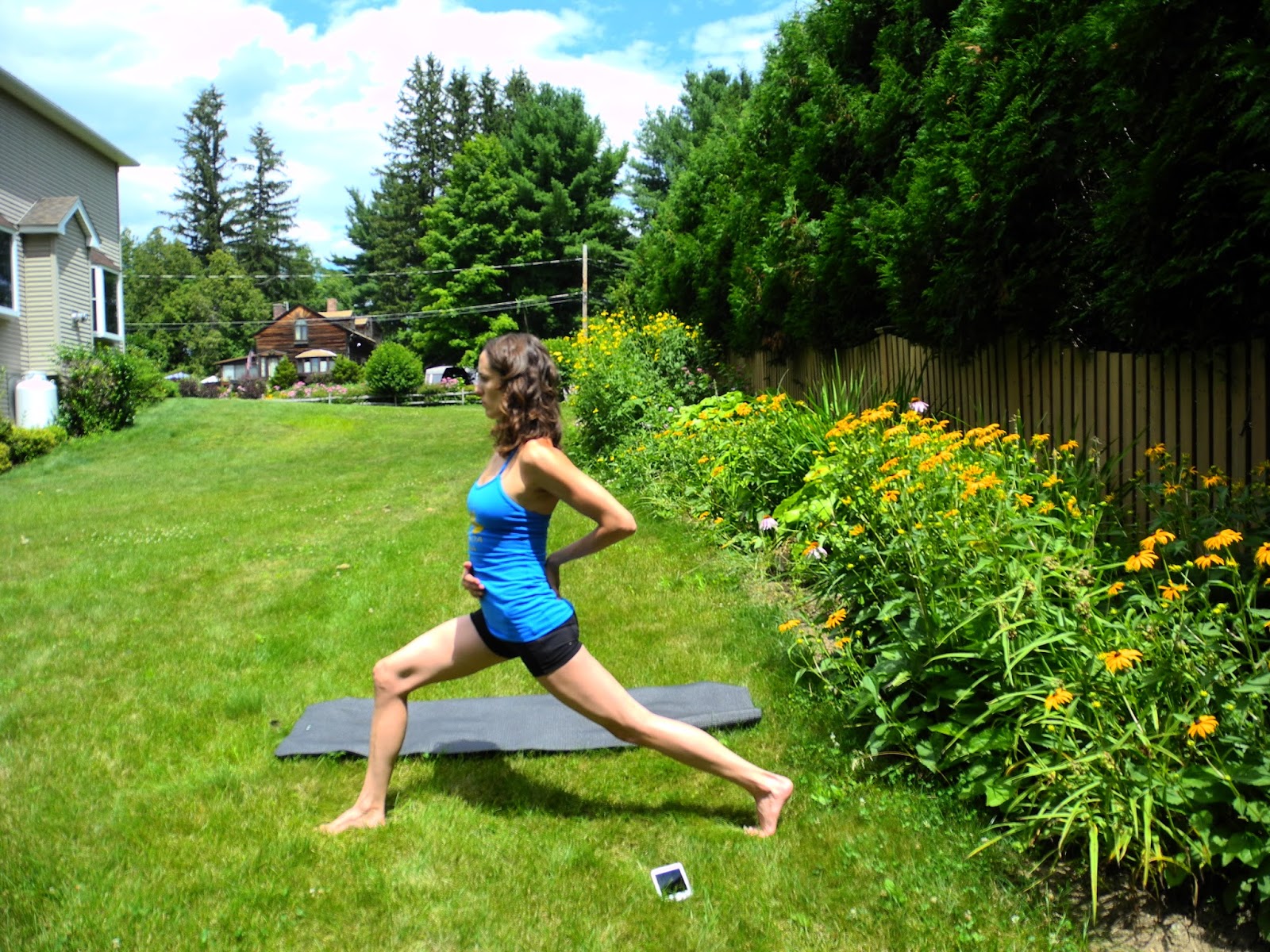
Crescent lunge/high lunge is a nice way to build strength and stability in the legs, and it is also a nice opening for the hip flexors - try it as a break from your workday if you have a sedentary job. Even though two feet are on the floor, the large distance between them can make this a challenging posture for balance. Feel free to stand close to a wall or chair to hold on to if you need help with balance. If you'd like a warmup posture,
check out last week's posture of the week: Boxy Lunge!
Crescent Lunge/High Lunge/Alanasana
 |
| Crescent lunge. |
To get into the posture:
Stand with your feet hip bone width (about 2 fist widths) apart at the front of your mat. Step your left foot straight back a little more than one of your leg lengths, making sure the feet stay hip bone width apart side to side. You can adjust the lunge to shallower or deeper front to back, depending on your strength and flexibility. Make sure whatever depth you choose, your right knee is directly on top of your right ankle rather than in front of it.
 |
Stand with feet hip bone width apart. You can measure hip bone width by two
of your own fist widths as pictured above. |
|
Refining the posture:
Adjust your spacing front to back so that your right knee is directly on top of your right ankle. If the knee presses forward of the ankle joint, the knee isn't happy. Also make sure your lunge isn't so wide that you are unable to bring your knee on top of your ankle! You can have as shallow or deep a lunge as you like, provided the right knee is on top of the ankle, AND the right hip doesn't go lower than the right knee. In other words, the right thighbone doesn't want to go farther down than parallel to the floor.
 |
| Make sure your front knee isn't forward of the ankle joint as pictured above... |
 |
...and also make sure your lunge isn't so wide you are unable to put your
front knee on top of your ankle joint, as above. |
 |
You can have a shallow lunge as pictured above, depending on your strength
and flexibility. A shallow lunge (with knee still directly on top of ankle) is
easier on both strength and flexibility. |
 |
| Make sure you don't sink your hips lower than your front knee as above. |
Make sure your belly isn't pressing forward and your low back collapsing. Try to draw your belly in and up and lengthen the low back. If this is difficult to feel, place one hand on belly and one hand on your sacrum (like we did last week in the
Boxy Lunge post!), straighten your front knee and press the tailbone down and the belly in and up with the help of your hands, then return your arms to your chosen position.
 |
| Here I am collapsed in my low back, causing it to overarch. |
 |
To help adjust out of a low back collapse, straighten the front knee a bit,
place 1 hand on low back and 1 hand on sacrum, and draw the belly in and
up while sending the tailbone down toward the floor, with the assistance of
your hands. |
 |
After adjusting the position, sink back down into your lunge without
losing the position of the pelvis. |
Adjust the back foot so the heel is stacked right on top of the ball of the foot, rather than pressing behind the ball of the foot. This helps you to balance your weight between your two feet, provides even more length through the front of your hip left hip, and strengthens the back leg.
 |
| Make sure your back heel isn't falling back behind the ball of the foot. |
 |
Try to place the back heel directly on top of the ball of the foot and energize
the whole back leg. |
Make sure your feet remain hip bone width apart side to side, rather than wider or closer together.
 |
Viewed from the front, you can see my feet aren't hip bone width apart;
they are too close together, creating a "tightrope" effect. |
|
 |
| And here my feet are farther apart than hip bone width. |
 |
| Try to place the feet at hip bone width apart as above. |
Make sure your shoulders are stacked right on top of your hips, rather than leaning forward or back.
 |
| Torso leaned too far forward, shoulders are forward of hips. |
 |
| Torso leaning too far back. |
|
 |
| Neutral - shoulders on top of hips. |
Arm options for crescent lunge include pressing your hands to heart center as in the above picture, lifting the arms high toward the sky, or temple clasp (folding your hands, but pointing the pointer fingers toward the sky).
|
| Arms high. |
 |
| Temple clasp. |
Hold the posture for 3-5 breaths, then switch sides so your left leg is forward!
For a precursor and warmup pose for this posture, or if this posture seems inaccessible for your body,
check out last week's posture of the week: Boxy Lunge!
Meowttakes!
 |
| I had kitties walking under my legs the whole time I was taking these photos. :) |
 |
Riddick tickles my foot with his whiskers, and I am getting irritated that
my camera remote isn't working. :) |